Revista Ítalo-Española de Derecho Procesal
pp. 21-28
Madrid, 2025
DOI: 10.37417/rivitsproc/2909
Marcial Pons Ediciones Jurídicas y Sociales
© Elena D’Alessandro
ISSN: 2605-5244
Recibido: 22/11/2024 | Aceptado: 30/01/2025
Editado bajo licencia Creative Commons Attribution 4.0 International License.
Empirical analysis on the Application of the EU Small Claims Regulation in Italy
Elena D’Alessandro
Full Professor of Civil Justice
University of Turin
ABSTRACT: The article explores the challenges faced in implementing the European Small Claims Regulation in Italy, focusing on issues such as a high number of appeals and disproportionate costs. It discusses the need for adjustments to achieve the ESCP’s objectives effectively. Despite these challenges, positive developments are also noted.
KEYWORDS: small claims; appeal; costs
SUMMARY: 1. AIM OF THE ESSAY.— 2. AVAILABLE STATISTICAL DATA.— 3. GEOGRAPHICAL CONSISTENCY IN THE APPLICATION OF THE ESCR.— 4. NATURE OF THE CLAIMS PROGRESSING TO THE APPELLATE STAGE.— 5. HIGH NUMBER OF APPEALS.— 6. COSTS OF THE APPELLATE PROCEEDINGS.— 7 CONCLUSIONS.
1. Aim of the essay
The European Small Claims Regulation (ESCR) represents a significant departure from traditional, lengthy, and complex cross-border legal procedures. Its primary objective is to enhance accessibility, efficiency, and fairness for individuals and businesses seeking to recover small claims arising from cross-border trade across the European Union.
This essay aims to offer an overview of the implementation of the ESCR in Italy, fifteen years after its introduction, based on the available statistical data.
2. Available statistical data
In a communication dated 13 November 2023, the Italian Ministry of Justice announced that the Department for Digital Transition, Statistical Analysis, and Cohesion Policies, through its General Directorate for Automated Information Systems (DGSIA), in line with the digitization goals of the National Recovery and Resilience Plan (PNRR), would soon launch an open-access “Database of Merit Case-Law.” The new database aims to provide citizens with open access to decisions in civil and commercial matters published by the tribunals of first instance and appellate courts from 1 January 2016.
The so called “Public Database of Merit Case-Law” 1 (hereinafter: Public Database) is a repository containing all civil judgments (judgments, decrees, and orders) published from 1 January 2016, in the first instance tribunals and appellate courts. Constantly updated, this database is intended for free use by all citizens and is fully compliant with the EU GDPR (Regulation (EU) 2016/679).
All judgments in the Public Database are made available to citizens in an anonymous form. Specifically, the identifying information of parties (individuals or legal entities) is pseudonymized, both in cases where the party is an individual, as required by the EU GDPR, and in cases where one of the parties is a legal entity (“party 1", “party 2", “counterparty 1", etc.). The names of lawyers assisting the parties (“lawyer 1", “lawyer 2”) are also anonymised, while the names of the judge(s) who drafted the judgment remain clear.
The Public Database aims to offer citizens, who are subject to civil justice”, the opportunity to freely access the full text of judgments (including orders or decrees) in civil matters issued by first instance or appellate courts. Moreover, the database offers “abstracts of the decisions” and includes a feature that provides links to conforming and diverging precedents and decisions from subsequent levels of jurisdiction. Users can conduct keyword and normative reference searches, and the platform supports natural language queries.
Access to the Public Database is restricted to users with SPID (Sistema Pubblico di Identità Digitale) Italian electronic identity cards or CNS (Carta Nazionale dei Servizi).
From our perspective, the introduction of the Public Database represents a significant development in understanding the practical application of the ESCR in Italy.
Covering the period from 1 January 2016, to 31 December 2023, the Public Database has gathered 89 appellate rulings concerning the ESCR, offering a comprehensive dataset for thorough analysis.
Our empirical analysis focuses exclusively on the appellate review process under the ESCR, as the Public Database contains only appellate judgments — that is, EU small claims cases that have progressed to the appellate stage — and does not include rulings from justices of the peace, who in Italy typically handle first-instance adjudications for disputes within the scope of the ESCR.
3. Geographical Consistency in the Application of the ESCR
Among the key insights derived from the compilation in the Public Database, geographical consistency stands out as a notable finding. The uniform application of the ESCR at the appellate level across various Italian regions (see Figure 1) demonstrates a geographically balanced approach to the use of the ESCR, with no apparent bias towards the historically wealthier or more industrially developed northern regions.
This geographical consistency highlights the effectiveness of the ESCR in establishing a standardised procedural framework for small claims throughout Italy, addressing potential regional disparities that could otherwise hinder equal access to justice.
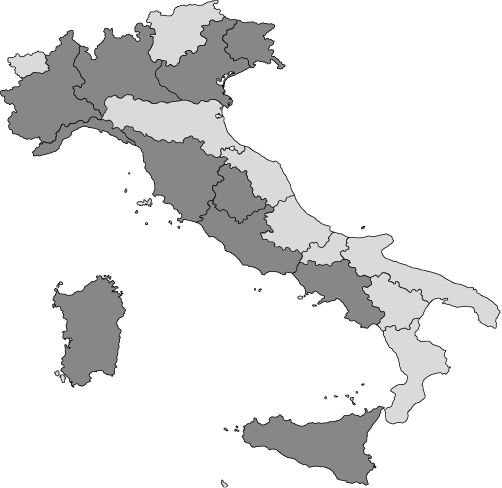
Figure 1: The Application of the ESPC – at the appellate stage – in Italy in the last 18 months (1 June 2022-31 December 2023) the dark gray Regions are the areas where the ESCR has been applied 2.
4. Nature of the claims progressing to the appellate stage
Another intriguing pattern highlighted by the Public Database is the nature of the ESCR claims advancing to the appellate stage, with a predominant focus on disputes regarding cancelled or delayed flights. This sector-specific trend signals a significant volume of activity within consumer law, particularly concerning passengers’ rights. The primary claimants in these cases are credit assignees—organisations that acquire claims from consumers in order to pursue legal action on their behalf.
5. High Number of Appeals
The data from the Public Database reveals a high rate of ESCR appeals, which contributes to the extension of the ESCR procedural timelines, with cases sometimes lasting up to two years—the current average duration of appellate proceedings in Italy 3.
This high rate of appeals stands in contrast to the ESCR’s goal of ensuring the swift resolution of cross-border small claims, exposing a disconnect between the regulation’s intended objectives and the practical realities of its implementation in Italy.
The time frame for the conclusion of ESCR proceedings in Italy is further extended by the provision that, beyond a first appeal, a second appeal is permitted (limited to issues of law) before the Italian Supreme Court, as stipulated in Article 111 of the Italian Constitution. This second appeal process is available even in cases involving relatively low-value disputes, potentially adding an additional three years to the total duration of ESCR proceedings before a final judgment is issued.
In summary, the reality in Italy is that there is a swift initial first-instance ESCR process, followed by a lengthy duration of at least two years for the first appeal and an additional three years for the resolution of the second appeal, resulting in a total timeframe of over five years!
It is evident that the interplay between European procedural law with the Italian lex fori, which permits two appeals, may significantly prolong the duration of ESCR proceedings.
This situation calls for a reconsideration of leaving the regulation of the appellate process to national legislators (lex fori), as stipulated by Article 19 of the ESCR. Such a reconsideration is essential to realign the ESCR with its core objectives of efficiency and expediency in resolving cross-border small claim disputes.
6. Costs of the Appellate Proceedings
Another issue that emerges from the text of appellate decisions available in the Public Database concerns the costs associated with appellate proceedings in cases falling under the ESCR. This is a significant concern, particularly in light of the content of Article 16 of the ESCR, which stipulates that the losing party should bear the costs of the proceedings, unless those costs were unreasonably incurred or disproportionate to the value of the claim.
However, Article 16 of the ESCR applies only to first-instance proceedings and does not extend to appellate proceedings, where instead the lex fori is applied. In Italy, this can result in situations where the costs awarded for appellate proceedings far exceed the value of the claim, thereby undermining the ESCR’s objective of providing a low-cost mechanism for resolving cross-border small claims disputes.
Within the Public Database, two emblematic cases highlight this issue:
1) The Tribunal of Turin 4, in an instance processed on 5 October 2022, ruled on an ESCR case involving a delayed flight with a claim value of €250 plus interest. The issue of international jurisdiction led to the dismissal of the case at the first instance. The appeal was similarly rejected by the tribunal. The costs incurred by the unsuccessful party throughout the ESCR proceedings (both first and second instances) amounted to €792 in lawyer’s fees. Additionally, as a sanction, the losing party was required by the Tribunal of Turin, in its capacity as the appellate court, to pay a court fee double the value of the claim, approximately €128, in accordance with Italian procedural law. This brings the total cost of the ESCR proceedings (first and second instance costs) for the losing party to around €1000, which is four times the value of the dispute.
2) The Tribunal of Ragusa 5, in a judgment dated 29 September 2022, decided on an appeal concerning a cancelled flight for which the Justice of the Peace of Modica, in first instance, had granted monetary compensation to the passenger.
The Tribunal of Ragusa, upon hearing the case, partially upheld the appeal, reducing the amount of compensation owed to the passenger in the first instance. Consequently, the passenger was required to reimburse the airline €502 and cover the legal costs for both the first and appellate instances. The total cost of the dispute for the first and second instances, in accordance with Italian civil procedural law, amounted to €2174, approximately 3-4 times the value of the dispute
It is evident that the absence of an EU cap on the costs of appellate proceedings, as determined by the lex fori, raises concerns about the accessibility of appellate review within the ESCR framework.
To address these challenges, the following measures could be considered:
A. Clarification and Amendment of ESCR Procedures: EU institutions and Member States could collaborate to provide greater clarity on the application of Article 16 of the ESCR in appellate proceedings. This could involve revising the ESCR to explicitly limit the total costs that can be awarded in appellate cases, ensuring they remain proportionate to the value of the claim.
B. Enhanced guidance for parties: Providing clear information on the European e-Justice Portal regarding the costs under the lex fori and the specific national procedural rules governing ESCR proceedings at the appellate stage could help parties make informed decisions about pursuing a small claim case in court. Such measures could not only assist in predicting costs but also potentially reduce the number of appeals filed.
C. Encouraging alternative dispute resolution methods for small claims, at least before progressing to the appellate stage. Mediation, in particular, and negotiation could serve as a cost-effective and timely approach to resolving disputes without the need for appellate review.
8. Conclusions
The challenges identified in the preceding paragraphs, stemming from the examination of decisions in the Public Database regarding the application of the ESCP in Italy — such as the high number of appeals and disproportionate costs relative to the claim value — highlight areas where adjustments and clarifications may be necessary to fully achieve the ESCP’s objectives of streamlining and expediting small claims disputes across the entire EU.
These issues point to the potential need for intervention by the European legislator, particularly to address challenges that may deter claimants from using the ESCP, ensuring its effective application within the varied legal frameworks of Member States.
At the same time, the data available in the Public Database demonstrates some positive advancements in the implementation of the ESCP in Italy.
The presence of 89 appellate decisions indicates significant usage of the ESCP within the country. Although the percentage of appeals is relatively high in Italy, it can be inferred that there were likely many more cases decided at first instance beyond the reported number of appellate decisions, probably exceeding one hundred.
Furthermore, the Public Database highlights the potential for the ESCP to integrate into national legal systems, with courts adopting the ESP Regulation and embracing digital practices. A notable example of this progress is a Tribunal of Florence’s ruling 6, which approved the submission of the defendant’s response in both, first and second instance ESCP proceedings, via certified email, thus effectively digitising the proceedings by equating this method of submission to traditional postal mail with a return receipt.
The quoted decision of the Tribunal of Florence exemplifies a positive development, demonstrating that not all aspects of the ESCP’s implementation in Italy are facing challenges, and it offers hope for further enhancements in its application within the country.
1 Available at https://bdp.giustizia.it/.
2 Source of Data: Italian Public Database.
3 According to the statistical data provided by the Italian Ministry of Justice, the average duration of appeal civil proceedings in the first semester of 2024 was 528 days. The statistics are available (in Italian) at https://datiestatistiche.giustizia.it/cmsresources/cms/documents/pnrr_relazione_indicatori_statistici_ott24.pdf (accessed on Jan. 27, 2025).
4 Tribunal of Turin, 5 October 2022, full text available in the Public Database.
5 Tribunal of Ragusa, 29 September 2022, full text available in the Public Database.
6 Tribunal of Florence, 18 September 2023, full text available in the Public Database.